

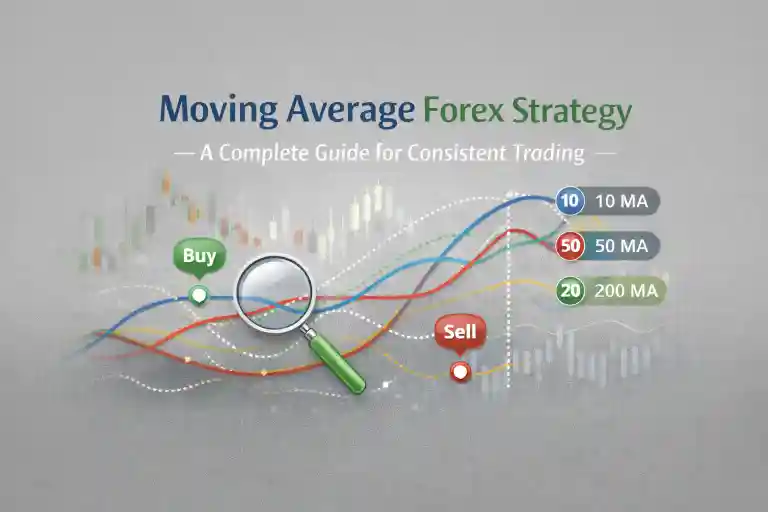
The Moving Average Forex Strategy is one of the most trusted and widely used trading approaches among forex traders. Whether you are just starting out or already have experience in the market, this strategy helps simplify decision-making by focusing on trend direction rather than market noise.
In the fast-moving forex market, price fluctuations can often appear confusing. Moving averages act as a smoothing tool, allowing traders to clearly identify trends and make structured trading decisions. Instead of guessing market direction, traders using this strategy rely on confirmed signals, making it a disciplined and practical approach.
What is a Moving Average in Forex Trading
A moving average is a technical indicator that calculates the average price of a currency pair over a specific period. By doing this, it reduces short-term volatility and provides a clearer picture of the market trend.
The Moving Average Forex Strategy uses these averages to determine whether the market is trending upward, downward, or moving sideways.
Types of Moving Averages
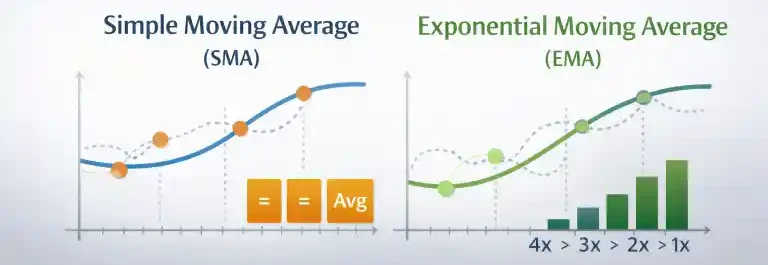
- Simple Moving Average (SMA): Calculates the average price over a fixed number of periods. It is smoother but reacts slower to price changes.
- Exponential Moving Average (EMA): Gives more importance to recent price data, making it faster and more responsive.
Most professional traders prefer EMA because it adapts quickly to market movements.
Core Concept of the Moving Average Forex Strategy
The Moving Average Forex Strategy is based on trend-following principles. Instead of predicting where the market will go, traders wait for confirmation and then follow the direction of the trend.
Moving averages also act as dynamic support and resistance levels. This means price often reacts around these levels, providing trading opportunities.
Popular Moving Average Setup
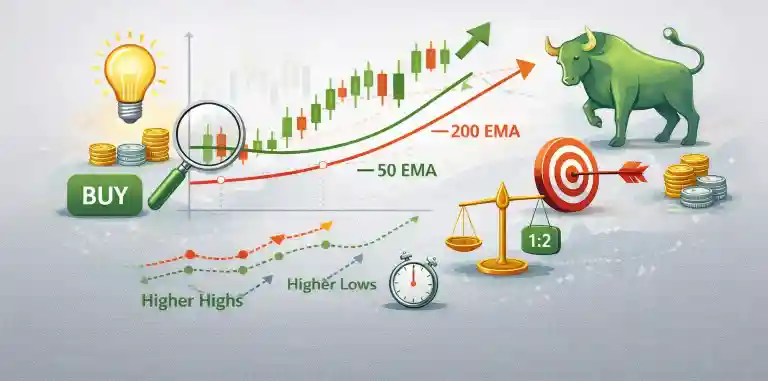
A commonly used and highly effective setup in the Moving Average Forex Strategy includes two EMAs:
- 50 EMA: Represents short-term trend direction
- 200 EMA: Represents long-term trend direction
This combination helps traders identify both the overall trend and precise entry points.
Buy Setup (Bullish Strategy)
A buying opportunity occurs when the market shows strong upward momentum.
Conditions for Buy Entry
- The 50 EMA crosses above the 200 EMA
- Price remains above both moving averages
- The market forms higher highs and higher lows
Trade Execution
- Entry: Wait for a pullback toward the 50 EMA
- Stop Loss: Place below the recent swing low
- Take Profit: Maintain a minimum risk-reward ratio of 1:2
This approach ensures that trades are taken in the direction of the dominant trend.
Sell Setup (Bearish Strategy)
A selling opportunity appears when the market is trending downward.
Conditions for Sell Entry
- The 50 EMA crosses below the 200 EMA
- Price stays below both moving averages
- The market creates lower highs and lower lows
Trade Execution
- Entry: Enter after a pullback to the 50 EMA
- Stop Loss: Place above the recent swing high
- Take Profit: Based on structure or fixed ratio
This setup helps traders capture downward trends efficiently.
Advantages of the Moving Average Forex Strategy
- Clearly identifies strong trends
- Helps reduce emotional trading decisions
- Suitable for beginners and experienced traders
- Works across different timeframes
- Can be combined with other indicators for confirmation
Limitations to Consider
While the Moving Average Forex Strategy is powerful, it is important to understand its limitations:
- Performs poorly in sideways or ranging markets
- Signals can be delayed due to the lagging nature of moving averages
- Requires patience and discipline
Understanding these limitations helps traders avoid common mistakes.
Best Timeframes for This Strategy
The Moving Average Forex Strategy can be applied across multiple trading styles:
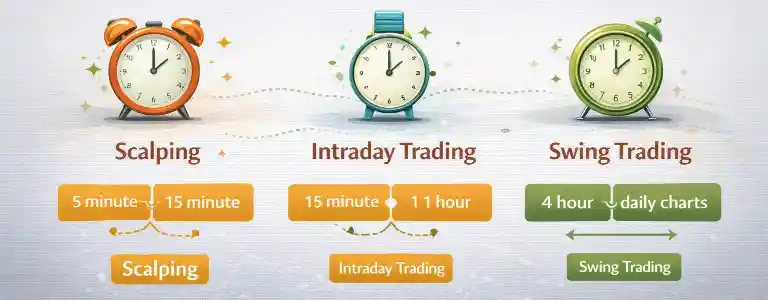
- Scalping: 5-minute to 15-minute charts
- Intraday Trading: 15-minute to 1-hour charts
- Swing Trading: 4-hour to daily charts
Choosing the right timeframe depends on your trading style and availability.
Risk Management and Trading Discipline
No trading strategy works consistently without proper risk management. The Moving Average Forex Strategy becomes significantly more effective when combined with disciplined money management.
- Risk only a small percentage of your account per trade
- Avoid over-leveraging
- Always use stop loss
- Follow a consistent risk-reward ratio
Consistency in risk control is what separates successful traders from beginners.
Combining Moving Averages with Other Tools
To improve accuracy, traders often combine the Moving Average Forex Strategy with additional indicators such as:
- RSI for overbought and oversold conditions
- Support and resistance levels
- Price action patterns
This multi-layer confirmation helps filter false signals.
Final Thoughts
The Moving Average Forex Strategy remains a foundational method for traders who want a structured and disciplined approach to the market. Its strength lies in simplicity, making it accessible to beginners while still being effective for experienced traders.
Instead of relying on complex indicators, this strategy focuses on trend direction and proper execution. When combined with patience, risk management, and market understanding, it can become a reliable part of any trading system.
If you are looking to build a consistent trading approach, mastering moving averages is a strong step forward.
For traders who want to combine price action with indicator-based confirmation, explore our detailed guide on Price Action Trading Strategy in Forex to build a more structured and reliable trading system.

