


Understanding what is trend in forex is one of the most important steps for any beginner trader. A trend represents the overall direction in which the market is moving over a period of time. Whether prices are rising, falling, or moving sideways, recognizing this direction helps traders make more informed and confident decisions.
Instead of guessing market movements, traders who understand trends focus on trading in alignment with market direction. This approach reduces unnecessary risk and improves consistency over time.
What is Trend in Forex
In simple terms, what is trend in forex can be explained as the general movement of price in a specific direction. It shows whether buyers or sellers are dominating the market.
- Uptrend: Market moves upward
- Downtrend: Market moves downward
- Sideways Trend: Market moves within a range
By identifying trends, traders can align their strategies with market momentum instead of trading blindly.
Types of Trends in Forex
To fully understand what is trend in forex, it’s important to learn about the three main types of trends that occur in the market.

1. Uptrend (Bullish Market)
An uptrend occurs when the price consistently moves higher. This means the market is forming higher highs and higher lows.
- Indicates strong buying pressure
- Buyers are in control of the market
- Traders focus on buying opportunities
In an uptrend, traders typically look for pullbacks or corrections to enter buy trades at better prices.
2. Downtrend (Bearish Market)
A downtrend forms when the price moves lower over time, creating lower highs and lower lows.
- Indicates strong selling pressure
- Sellers dominate the market
- Traders focus on selling opportunities
In this scenario, traders aim to sell during retracements rather than buying against the trend.
3. Sideways Trend (Range Market)
A sideways trend occurs when the market lacks a clear direction. Prices move between support and resistance levels.
- No dominant buyers or sellers
- Price stays within a range
- Common in low volatility conditions
This type of market is suitable for range trading strategies, but trend-following strategies may not perform well here.
How to Identify a Trend in Forex
If you’re learning what is trend in forex, identifying it correctly is essential. Traders use several methods to determine market direction.
1.Price Action: This is the most basic and reliable method. By observing price movement:
- Higher highs and higher lows indicate an uptrend
- Lower highs and lower lows indicate a downtrend
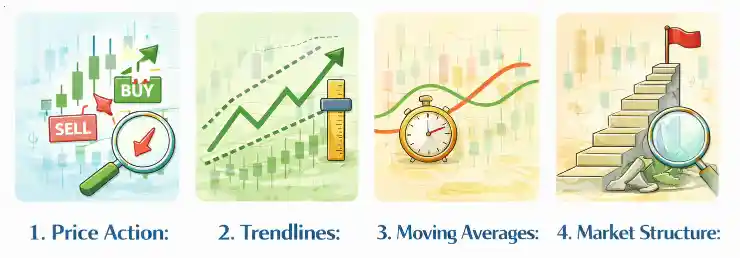
2.Trendlines: Trendlines are drawn to connect highs or lows on a chart. They visually represent the direction of the market.
3.Moving Averages: Moving averages smooth out price data and help identify the overall trend direction.
4.Market Structure: Understanding how price forms patterns over time gives deeper insight into trend behavior.
Among all methods, observing highs and lows is the simplest way for beginners to understand what is trend in forex.
Trend and Support & Resistance
Trend analysis works closely with support and resistance levels. These levels act as key areas where price reacts.
- In an uptrend: Support levels are important for buying opportunities
- In a downtrend: Resistance levels are important for selling opportunities
Combining trend direction with support and resistance helps traders find better entry and exit points.
Why Trend is Important in Forex Trading
Understanding what is trend in forex provides several advantages for traders:
- Helps identify the correct market direction
- Improves trade accuracy
- Reduces unnecessary risk
- Increases probability of successful trades
There is a popular saying in trading: “The trend is your friend.” This means trading in the direction of the trend generally offers better outcomes than going against it.
How to Trade with the Trend
Once you understand what is trend in forex, the next step is applying it in real trading.

- Buy when the market is in an uptrend
- Sell when the market is in a downtrend
- Avoid trading against the trend
Following the trend increases the probability of success because you are trading with market momentum rather than against it.
Common Mistakes Traders Make
Many beginners struggle even after learning what is trend in forex because of common mistakes:
- Trading against the trend
- Incorrectly identifying market structure
- Entering trades too early without confirmation
- Ignoring key levels like support and resistance
Avoiding these mistakes can significantly improve your trading performance.
Pro Tips for Beginners
Here are some practical tips to help you apply what is trend in forex effectively:
- Always identify the trend before placing a trade
- Use higher timeframes for clearer trend direction
- Combine trend analysis with support and resistance
- Avoid overtrading in sideways markets
- Wait for confirmation before entering trades
Final Thoughts
Learning what is trend in forex is a foundational skill for every trader. It provides clarity about market direction and helps traders make logical, data-driven decisions instead of emotional ones.
For beginners, mastering trend identification and trading in the direction of the trend can greatly improve consistency and long-term success. With practice and discipline, this simple concept can become a powerful part of your trading strategy.
To strengthen your trading strategy, you should also learn about Support and Resistance in Forex and Order Types in Forex, as they help in executing trades according to market direction.

